In May 2026, the NASA/ESA/CSA James Webb Space Telescope turned its powerful infrared gaze toward Messier 77 (M77), a barred spiral galaxy that has long captivated astronomers. Located about 45 million light-years away in the constellation Cetus (The Whale), this galaxy is a treasure trove of cosmic phenomena—from a supermassive black hole to intense star formation. In this listicle, we explore ten key aspects of M77 revealed by Webb’s latest Picture of the Month, shedding light on its structure, dynamics, and scientific significance.
1. The Galaxy’s Identity and Location
M77, also cataloged as NGC 1068, is one of the most well-known barred spiral galaxies in the night sky. It lies approximately 45 million light-years from Earth in the southern constellation Cetus, The Whale. This proximity makes it an ideal target for detailed study, as its features are relatively bright and resolvable even with modest telescopes. The galaxy’s designation as Messier 77 comes from Charles Messier’s 18th-century catalog, but its modern fame stems from its role as a prototype for active galactic nuclei. Webb’s image captures the galaxy’s bright core and intricate spiral arms, offering a fresh perspective on this cosmic neighbor.
2. A Barred Spiral Structure
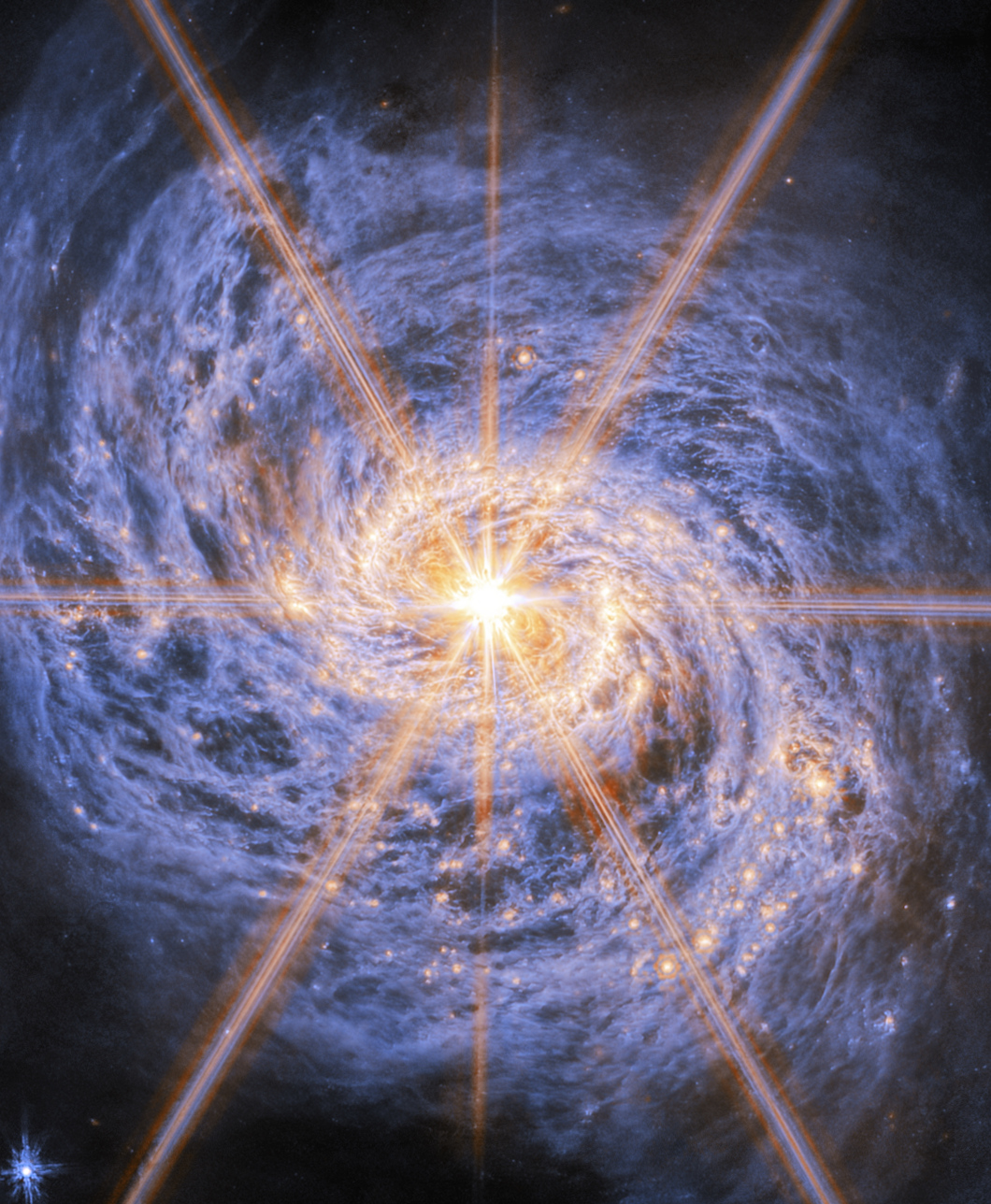
M77 is classified as a barred spiral galaxy, meaning it has a central bar-shaped structure composed of stars and gas. This bar funnels material toward the galaxy’s core, fueling the central supermassive black hole. In Webb’s image, the bar appears as a luminous elongated region surrounded by tightly wound spiral arms. The arms are studded with regions of active star formation, visible as glowing knots in infrared. The bar itself is a key player in the galaxy’s evolution, regulating gas inflow and triggering bursts of stellar birth. Understanding such structures helps astronomers model how galaxies evolve over billions of years.
3. A Seyfert Galaxy with an Active Nucleus
M77 is a classic example of a Seyfert galaxy—a type of active galactic nucleus (AGN) that emits intense radiation from its center. Discovered by Carl Seyfert in 1943, it is one of the brightest and closest members of this class. The central engine is a supermassive black hole, millions of times the mass of the Sun. As material spirals into the black hole, it releases vast amounts of energy across the electromagnetic spectrum. Webb’s infrared observations are particularly valuable because they can pierce through the dusty torus that often obscures visible light, revealing the heart of the AGN.
4. The Supermassive Black Hole at Its Core
At the center of M77 lies a supermassive black hole with an estimated mass of about 15 million solar masses. This black hole is not directly visible, but its presence is inferred from the motion of gas and stars in the core. The strong gravitational pull drags gas into a tight, fast orbit, causing the gas to heat up to millions of degrees and emit enormous amounts of radiation. Webb’s image captures this glow as an intense, point-like source at the galaxy’s center. The black hole’s activity makes M77 a natural laboratory for studying the interplay between black holes and their host galaxies.
5. The Bright Glow from Hot Gas
The heart of M77 shines brilliantly in Webb’s image, thanks to gas being heated by the extreme environment near the black hole. As gas falls toward the event horizon, friction and magnetic forces heat it to temperatures exceeding 10 million Kelvin. This hot gas emits primarily in X-rays and ultraviolet, but some infrared radiation escapes, which Webb can detect. The glow is so intense that it outshines the combined light of billions of stars in the galaxy. This phenomenon is common in AGNs, but M77’s relative closeness allows astronomers to study the process in unprecedented detail.
6. Webb’s Infrared Vision Penetrates Dust
One of the key advantages of the James Webb Space Telescope is its ability to observe in infrared wavelengths, which can pass through cosmic dust clouds that block visible light. M77’s nucleus is surrounded by a dusty torus—a donut-shaped region that obscures the direct view of the black hole in optical telescopes. Webb’s Mid-Infrared Instrument (MIRI) and Near-Infrared Camera (NIRCam) reveal structures hidden from Hubble’s view. For example, the warm dust heated by the AGN shows up as bright infrared emission, allowing astronomers to map the distribution of material around the core.

7. Diffraction Spikes: An Optical Artifact
The bright lines radiating from the center of M77 in Webb’s image are not actual features of the galaxy. They are diffraction spikes caused by the telescope’s segmented mirror and support struts. This is a well-known optical effect, similar to how stars appear with spikes in many astronomical images. The spikes are symmetrical and can help calibrate the instrument, but they sometimes obscure fine details in the galaxy’s core. Astronomers use processing techniques to minimize their impact, but they are a natural consequence of Webb’s design. Despite this, the spikes add a dramatic aesthetic to the image.
8. Star Formation in the Surrounding Disk
While the core is dominated by the AGN, the spiral arms of M77 are vibrant with star formation. Webb’s infrared data highlights regions where young, hot stars are embedded in dense clouds of gas and dust. These stellar nurseries appear as bright clumps along the arms, often tracing the spiral pattern. The bar also plays a role by channeling gas inward, which can trigger bursts of star formation in the central region. Studying these star-forming regions helps astronomers understand the efficiency of star formation in different galactic environments, especially near an active nucleus.
9. The Importance of M77 for Astronomical Research
M77 has been a cornerstone for understanding active galactic nuclei for decades. Its combination of brightness, moderate distance, and well-studied features makes it a benchmark for testing models of AGN physics. Webb’s observations add a new dimension by resolving structures at infrared wavelengths that were previously blurred. For instance, astronomers can now study the heating of dust by the AGN and measure the rate of gas inflow. M77 also serves as a calibrator for other AGN studies, helping to refine our understanding of the universe’s most energetic phenomena.
10. The May 2026 Image: A New View
The Picture of the Month released on May 7, 2026, showcases M77 in unprecedented detail. Captured by Webb’s NIRCam and MIRI instruments, the image reveals the galaxy’s bar, spiral arms, and intense core. The data are part of ongoing surveys to characterize nearby AGNs. This image not only provides a stunning visual but also supports scientific investigations into black hole growth and galaxy evolution. As astronomers analyze the data, they expect to uncover new insights about the relationship between M77’s central engine and its surrounding environment. The image stands as a testament to Webb’s revolutionary capabilities.
In conclusion, Messier 77 is far more than a pretty picture. Its barred spiral structure, active nucleus, and nearby location make it a crucial target for understanding the cosmos. The James Webb Space Telescope’s latest image offers an unprecedented view of this galaxy’s heart, revealing intricate details about the supermassive black hole and the gas it consumes. From diffraction spikes to star-forming regions, each feature tells a story of cosmic forces at work. As studies continue, M77 will undoubtedly remain a beacon of light in our quest to comprehend the universe.