A Quarter Century of Discovery
On April 15, 2026, a gathering of current and former team members from NASA's 2001 Mars Odyssey orbiter mission marked a remarkable milestone: 25 years since the spacecraft's launch on April 7, 2001. The celebration, held at NASA's Jet Propulsion Laboratory (JPL) in Southern California, featured the unveiling of a giant global map of Mars created from imagery collected by Odyssey's Thermal Emission Imaging System (THEMIS) infrared camera. This map is not just a piece of art; it represents decades of scientific exploration and serves as a testament to the enduring legacy of one of NASA's most successful Mars missions.
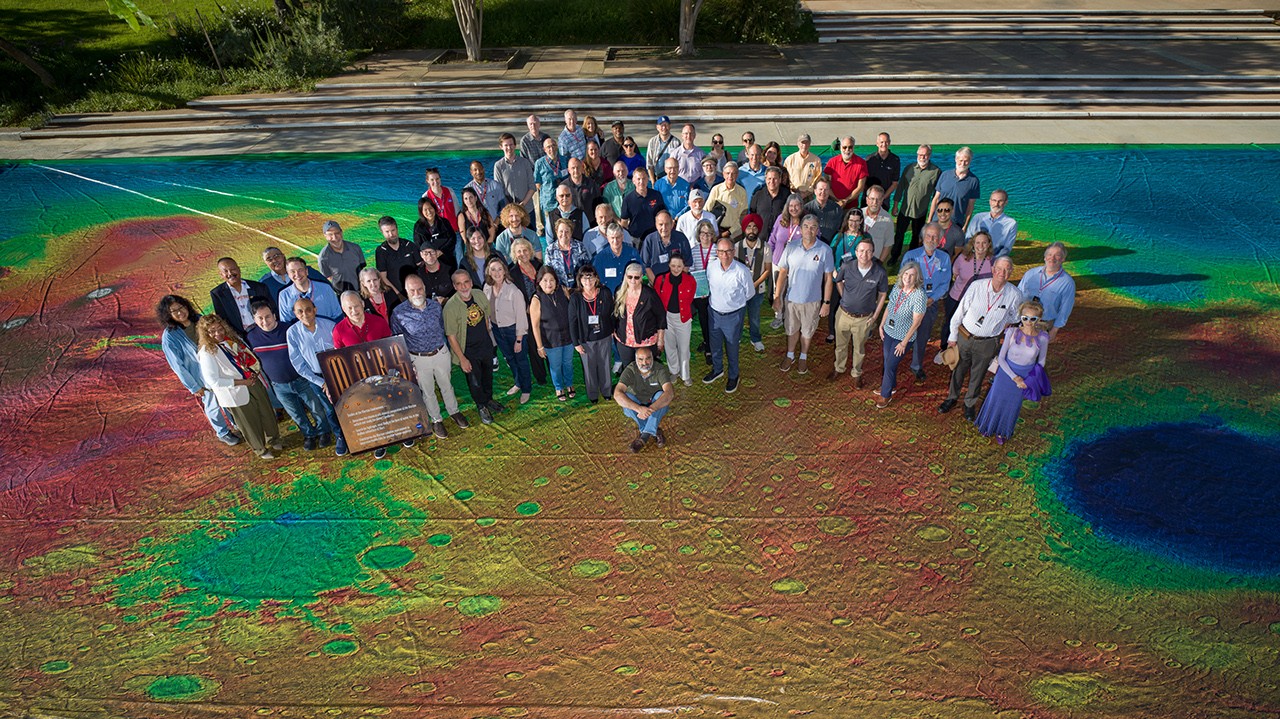
Odyssey's journey began in 2001, and over the subsequent quarter-century, the orbiter has revolutionized our understanding of the Red Planet. From mapping minerals and searching for water ice to providing critical communication relays for rovers like Spirit, Opportunity, and Curiosity, Odyssey has become a cornerstone of Mars exploration. The 25th-anniversary event was a moment to honor the dedicated scientists, engineers, and technicians who have made this mission possible.
The Global Map: A Masterpiece of Infrared Imaging
The centerpiece of the anniversary celebration was the enormous printed global map of Mars, produced using data from THEMIS. This instrument captures images in the thermal infrared spectrum, allowing scientists to see temperature variations and identify surface compositions even at night. The map, assembled from thousands of individual THEMIS images, provides a comprehensive view of the Martian surface with unprecedented detail.
THEMIS has been instrumental in detecting deposits of water ice, mapping the distribution of silicate minerals, and studying the planet's thermal properties. The global map unveiled at JPL is not only a scientific resource but also a visual representation of the mission's achievements. It highlights features such as the vast Valles Marineris canyon system, the polar ice caps, and the ancient highlands.
How the Map Was Made
Creating a global map from THEMIS data is a complex process. The camera orbits Mars on a polar trajectory, capturing swaths of thermal images as the planet rotates. Over time, these swaths are mosaicked together to form a seamless map. Each pixel in the map represents a specific thermal emission value, which can be correlated to surface composition and physical properties. The resulting mosaic required careful calibration to ensure consistency across different lighting conditions and seasonal changes.
The team's decision to print the map on a large scale for the anniversary was a deliberate choice to emphasize the beauty of Mars and the mission's accomplishments. Attendees could walk around the map, examining details that have been studied for years.
Legacy of the 2001 Mars Odyssey Mission
Odyssey's longevity is remarkable—originally designed for a two-year primary mission, it has now operated for over 25 years, making it the longest-working Mars spacecraft in history (surpassing the previous record held by the Mars Global Surveyor). Its extended mission has allowed scientists to monitor seasonal changes, dust storms, and long-term climate patterns on Mars.

Key discoveries include the detection of vast underground water ice in the mid-latitudes, which is essential for future human exploration. Odyssey also provided crucial data for landing site selection for the Spirit and Opportunity rovers, and it continues to serve as a communication relay for NASA's Perseverance rover and the Ingenuity helicopter. The mission's data has been used in thousands of scientific papers, advancing our knowledge of Martian geology, hydrology, and atmospheric dynamics.
Science Highlights
- Water Ice Mapping: THEMIS revealed abundant water ice just beneath the surface at high latitudes, a resource that could support future astronauts.
- Mineral Composition: Identification of olivine, pyroxene, and other minerals has helped reconstruct the planet's geological history.
- Thermal Inertia Studies: Measuring how quickly the surface temperature changes reveals information about particle size and rock abundance.
- Atmospheric Monitoring: Odyssey has tracked dust storms, clouds, and temperature variations over multiple Martian years.
The anniversary celebration also looked to the future. As NASA prepares for new missions to Mars, including the Mars Sample Return campaign, Odyssey's data and operational experience will continue to be invaluable. The global map unveiled at JPL is a symbol of how far we have come and an inspiration for what lies ahead.
Community and Collaboration
The event brought together team members from various stages of the mission, some of whom had not seen each other for years. It was a reunion of the Odyssey family, with presentations on the mission's history and technical achievements. One attendee noted, "This mission has been a labor of love, and seeing the global map made us all realize how much we've accomplished together."
For more on how Odyssey's data has been used, explore our Science Highlights section, or learn about THEMIS updates (internal anchor link). The map itself is available as a downloadable high-resolution JPEG (18.11 MB) from the Photojournal.
As Odyssey continues to orbit Mars, its legacy grows. The 25th-anniversary celebration was not just a look back—it was a reaffirmation of the spirit of exploration that drives humanity to reach for the stars.